

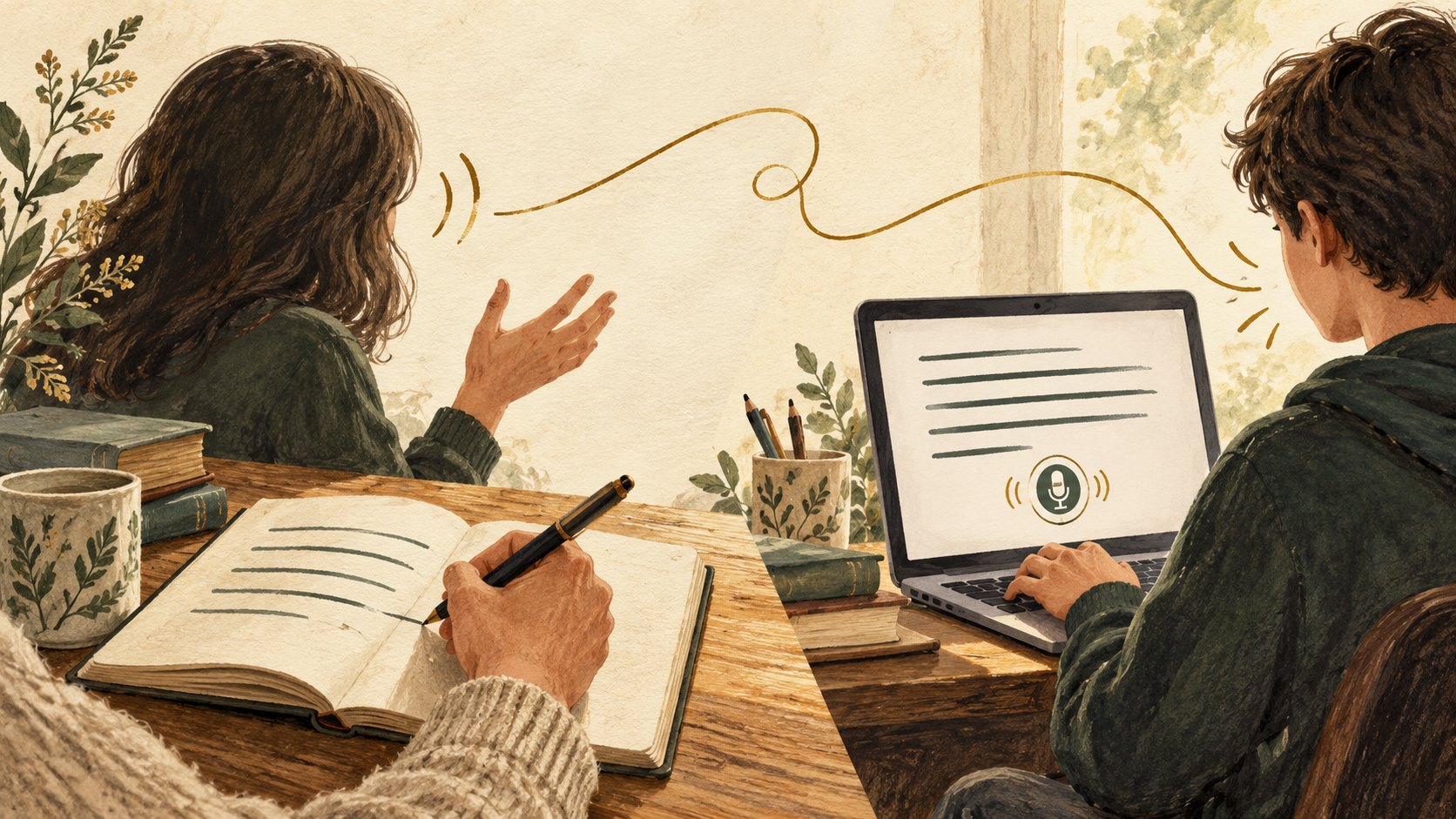
Sometimes my 14-year-old has something to say. He just doesn’t necessarily want to say it to me.
And that’s fair. He’s 14. Sometimes the last person he wants to sit down and explain everything to is Mom.
But if the goal is to help him get his ideas onto the page, I don’t necessarily need to be the person he talks them through with.
That’s one of the reasons we’ve started exploring speech-to-text technology in our homeschool. It gives him a way to get his thoughts out without having to physically write every word or dictate everything directly to me.
And it actually builds on an idea I came across years ago.

When my kids were younger, I discovered Jot It Down! from Julie Bogart’s Brave Writer. The idea was simple: let your child tell you a story while you write down their words. They get to focus on storytelling, and you handle the actual writing.
I loved that idea.
My kids? Well, we made it through about one story before they were both over sharing their ideas with Mom.
So that was the end of that.
But the underlying idea stuck with me. Because what happens when a child has something to say, understands what they’ve learned, and can explain it perfectly well, but the actual process of writing it down gets in the way?
What are we actually asking them to do?
Think about a typical homeschool assignment.
“Write a paragraph about Sequoyah.”
Sounds simple enough, right?
Except now your child has to remember what they learned about Sequoyah, decide which details are important, organize those details into a logical order, figure out how to phrase everything, spell the words, remember punctuation, and physically write the whole thing down.
That’s a lot of different skills being used for one assignment.
And if your child hands you a blank page, what does that actually tell you?
Do they not understand the history? Are they struggling to organize their thoughts? Is handwriting difficult? Did the assignment become overwhelming before they could even get started?
We don’t necessarily know.
This is why I try to start with the actual learning goal.
If we’re studying Sequoyah and the Cherokee syllabary, I want to know whether my kids understand what a syllabary is, why Sequoyah developed one, and how a writing system can change the way people communicate and preserve information.
But if I require them to write a properly structured paragraph to demonstrate that understanding, I’ve introduced several other skills into the assignment.
Suddenly, our history lesson has become a handwriting, spelling, grammar, and composition lesson, too.
And sometimes that’s appropriate. Sometimes those are exactly the skills we need to work on.
But not every time.
Have you ever been asked to do one thing, only to discover you’re being judged on five other things you weren’t even trying to demonstrate?
Yeah. It’s a little like that.
Why we’ve moved toward discussion-based learning
We’re a neurodivergent family.
Both my kids have ADHD, my husband is dyslexic, and my own brain has a tendency to race several thoughts ahead of whoever is speaking.
So communication and the way we process information are things I’ve spent a lot of time thinking about.
And over the years, we’ve changed quite a bit about how we homeschool because of that.
One of the things I’ve noticed about traditional curriculum, including a lot of homeschool curriculum, is just how much writing gets built into everything.
History comes with a workbook. Science comes with written questions. Reading comprehension comes with another set of written responses.
Even when the subject itself has very little to do with handwriting, the expectation is often that children will demonstrate what they’ve learned by writing it down.
And for some kids, that works perfectly well.
For others, the writing becomes the obstacle.
Maybe forming letters takes more effort than the actual thinking. Maybe the child has a hard time getting thoughts into the right order. Maybe the pencil feels uncomfortable, or the texture of the paper is distracting enough that concentrating on the assignment becomes difficult.
And from the outside, that can look a whole lot like resistance.
I’ve seen that happen in our own homeschool.
So instead of continuing to make written assignments the primary way my kids demonstrate their learning, we’ve moved toward a more Socratic, discussion-based approach.
We ask questions. We talk through ideas. We challenge assumptions and make connections to things we’ve learned before.
And because I’m teaching two kids at different grade levels, those conversations often become collaborative.
One of them will say something that sparks an idea in the other. They’ll approach the same information differently, and suddenly we’re discussing something I hadn’t necessarily planned to cover that day.
I still have learning goals. I’m still teaching the material.
But I don’t need every discussion to end with a completed worksheet to know that learning is happening.
I need to pay attention to what they’re understanding, where they’re making connections, and where they still need support.
And sometimes that means asking a few more questions to find out what each of them understands independently.
Sometimes the conversation is the lesson
Here’s an example from our homeschool.
We were listening to an astrophysics audiobook by Neil deGrasse Tyson, and he brought up the hypothesis that life on Earth could have originated from material that came from Mars.
Which, of course, sent my brain straight to the possibility that we could technically all be Martians.
I mean, that’s a pretty interesting thing to think about.
Afterward, I asked the kids what they found interesting about the chapter.
That’s something I do frequently. I don’t necessarily start by asking them to summarize everything or repeat a list of facts. I want to know what caught their attention.
Kim brought up the possibility of life coming from Mars.
So I asked her how she felt about that.
And she really wasn’t bothered by it.
Which I found interesting in itself, because something that made me stop and think was just another possibility to consider for her.
Now, that conversation wasn’t a formal assessment of everything we’d just listened to. We weren’t sitting there going through a list of questions about astrophysics.
We were talking about an idea she found interesting.
And that’s often where our discussions begin.
Sometimes I repeat something they’ve said using vocabulary we just learned. Sometimes I ask them to explain what they mean. Sometimes I bring up another piece of information and ask how they think it connects.
We’re working on communication, reasoning, and understanding at the same time.
But that doesn’t mean I need to write down every word they say.
Most of the time, we don’t.
We have the conversation, explore the ideas, and move on.
And that’s where I’ve started seeing another possibility.
What if we took some of those conversations and used them as the starting point for writing?
Writing is still part of our homeschool
I want to clarify something here, because I know how conversations about accommodations and writing can go.
My kids know the foundations of handwriting.
They learned their letters. They know how to form them. They can read, and they can write their names.
What we haven’t done a lot of is physically writing full sentences, paragraphs, and papers in the traditional format.
Not because I don’t think writing matters.
We’ve actually tried to work on those skills multiple times over the years.
But each time we pushed toward longer, more structured writing assignments, we ran into the same problem.
Resistance, frustration, and eventually both kids shutting down.
And at that point, we weren’t accomplishing what we’d set out to teach.
So we continued working on communication and developing ideas through discussion, while looking for ways to approach written composition that wouldn’t create the same barriers.
Now Chris is 14, and Kim turns 11 today.
And they’re starting to show an interest in being able to write their thoughts in a more structured way.
So we’re approaching it differently.
Instead of expecting them to come up with an idea, organize it, spell everything correctly, remember punctuation, and physically write it down all at once, we’re beginning to separate those skills.
First, we can dictate our thoughts and get them into a document.
Then we can actually look at what we’ve said.
Because the way we speak isn’t always the way we write.
When we’re talking, we might jump between ideas, leave sentences unfinished, or assume the other person understands something we haven’t fully explained.
Writing asks us to make those connections visible for someone who wasn’t part of the conversation.
And that’s something we can work on.
We can look at a transcription and ask whether the sentences make sense. Whether we need punctuation. Whether two thoughts belong together. Whether there’s a clearer way to explain what we’re trying to say.
We can practice editing and organizing ideas before adding the physical handwriting component.
And then we can deliberately work on writing those sentences by hand, too.
We’re at the beginning of this approach, so I’m not going to pretend we’ve already figured everything out.
But it gives us another way to work on writing without asking the kids to manage every part of the process simultaneously.
Or let them work it out privately
This brings me back to the original idea behind Jot It Down!.
Having an adult write down a child’s words can be a useful way to separate storytelling or composition from the physical act of handwriting.
But it didn’t really fit my kids.
And now that they’re older, there’s another piece to consider.
Independence.
Sometimes my son has an idea he wants to explore, but he doesn’t necessarily want to talk it through with me.
And that’s okay.
Speech-to-text gives him the opportunity to talk through those thoughts privately and decide what he wants to share afterward.
He can dictate into a phone, tablet, or computer, review what was captured, and begin editing it into something he wants to keep.

He doesn’t need me sitting beside him writing every word.
And he doesn’t need an AI generating an answer for him, either.
That’s an important distinction.
The technology can capture his words. It can help make those thoughts visible on the page.
But the ideas still need to come from him.
For families considering this, you don’t necessarily need a complicated AI tool. Basic dictation features may be enough. You’ll want to check age requirements, privacy settings, and how recordings or transcripts are stored before choosing what to use.
And if your child prefers talking to you while you write, that’s still an option.
The point is to find a way for them to communicate their ideas without the method becoming a bigger obstacle than the learning itself.
Accommodations aren’t the same as lowering expectations
I’ve actually talked about this on TikTok before.
And I had a public school teacher get upset with me over the idea of changing how children complete their assignments.
Which I found interesting, because public schools already use accommodations for exactly these kinds of challenges.
Depending on a student’s needs, an IEP or other accommodation plan might include dictation, speech-to-text, alternative response formats, or support with written assignments.
The idea of separating a student’s understanding of a subject from a difficulty with handwriting isn’t something unique to homeschooling.
The difference for us is that I don’t have to go through a formal school IEP process before making those instructional adjustments at home.
If I notice that the writing requirement is getting in the way of a history lesson, I can change how my kids respond.
If they need to explain something verbally, we can do that.
If they need another way to organize their thoughts, we can try one.
And if the goal is specifically to practice handwriting or written composition, I can make that the focus instead of burying it inside an unrelated assignment.
That doesn’t mean accommodations automatically solve every difficulty. And it doesn’t mean a child understands a subject simply because they can participate in a conversation.
I still have to pay attention, ask questions, check their understanding, and decide what needs to be taught next.
But I can make those decisions based on what I’m seeing in real time.
I don’t have to keep requiring the same format simply because that’s how the curriculum was written.
Use what you learn to decide what comes next
This is where the distinction between understanding, communication, and writing becomes important.
If my child can explain something verbally but struggles to write it down, that gives me useful information.
It doesn’t necessarily mean the lesson was too difficult or that they weren’t paying attention.
Maybe the challenge is organizing the information. Maybe it’s spelling or handwriting. Maybe they need more practice expressing a complete thought in writing.
And maybe the explanation itself reveals something they misunderstood.
Those are different things to address.
If the science concept is confusing, we can revisit the science.
If they’re having difficulty explaining the concept, we can practice communicating the idea.
If the goal is writing, we can work on sentence construction, punctuation, organization, and eventually longer compositions.
And this is one reason I still like using our Sequoyah lesson as an example.
On the Whitless Academy homeschool page, I’ve shared a lesson about Sequoyah and the Cherokee writing system.
It’s a lesson about language, communication, and the development of a writing system.
There are opportunities to discuss why written language matters, how a syllabary represents speech, and what changes when people can record information for someone else to read.
Those discussions can help us explore the history and ideas behind the lesson.
But they can also lead naturally into conversations about writing itself.
How do we take something we can say aloud and turn it into something another person can read?
That’s a question we’re beginning to work through in our own homeschool.
And I would much rather start with an idea my kids actually want to communicate than automatically hand them another worksheet full of sentences they have to copy.
Keep teaching the skills you’re helping with
None of this means we should ignore handwriting, grammar, spelling, or written composition.
Those skills have value.
Learning how to organize ideas, make a clear argument, communicate information accurately, and revise something we’ve written matters.
And sometimes understanding grammar helps us see why a sentence isn’t communicating what we intended.
But I also think we need to ask whether every single subject needs to become a writing assignment.
If we’re studying history, I want to know whether my children understand the history.
If we’re studying science, I want to know whether they can explain the scientific ideas and reason through what we’ve learned.
If we’re practicing writing, then let’s practice writing.
We can teach those skills separately and gradually bring them together.
Brave Writer currently presents Jot It Down! as a resource for younger writers, and its stages of growth guidance discusses writing development across different ages. I’m not suggesting that parent transcription or speech-to-text replaces age-appropriate writing instruction.
I’m looking at how we can make that instruction more accessible.
And as a homeschool parent, I can adjust the route based on what my kids are ready to work on and what actually helps them learn.
Sometimes that might mean a conversation.
Sometimes it might mean dictation, transcription, or editing a sentence together.
And sometimes it might mean sitting down with a pencil and practicing the physical act of writing.
The difference is that I’m making those choices intentionally.
I don’t want my kids to spend their entire education believing they don’t understand something simply because they couldn’t get the answer onto a piece of paper.
I want them to develop the ability to think, question, communicate, and eventually express those ideas clearly in writing.
And we don’t have to make every lesson depend on handwriting to get there.