


I love using AI to help build our homeschool lessons. Teaching guides, learning websites, even magazines when we want to dig further into a subject. It can research, pull information together, find videos, and turn a collection of scattered resources into something I can actually teach from.
But there’s a lot you don’t see when you look at the finished guide.
You don’t see the sources I had to double-check, the interesting rabbit trails I decided not to follow, or the discussion questions I sent back because they could have been copied into literally any lesson.
And you don’t see how often I look at something and go, okay, that’s not quite what I wanted. Let’s try that again.
So I want to show you what I’m actually asking AI to do, and where I still have to make the decisions. Because those are two different parts of the work.
I don’t start with a prompt
I start with what we’re learning.
Our homeschool year has an overall direction, and then I work in eight-week chunks to create the books and teaching guides we’re going to use. I’m not asking AI to invent our entire school day for me. I already know the direction we’re heading.
What I need to work out is what we should understand by the end of a lesson. What questions do we have? Is there a connection to something else we’re studying? Is there a part of the subject I never really understood myself and want to explore alongside the kids?
That’s the fun part for me. I like following the connections. I just don’t want to spend hours tracking down and formatting every piece of material that helps us follow them.

Take history. We might be studying the 1917 Night of Terror, when women campaigning for the vote were imprisoned and mistreated, or the destruction of Tulsa’s Greenwood district, known as Black Wall Street, in 1921. I don’t want the kids to memorize a date and move on. I want us asking what led to it, whose accounts we’re reading, what happened afterward, and why these events still matter. How do you explain something that serious in a way that’s accurate and appropriate for your kids without watering down the history? That’s a teaching decision, not just a research task.
AI can help me investigate all of that. Sometimes it brings back something that changes my original plan. That’s fine. I’m willing to change the plan when the research gives me a good reason to. But I need to understand why we’re changing it.
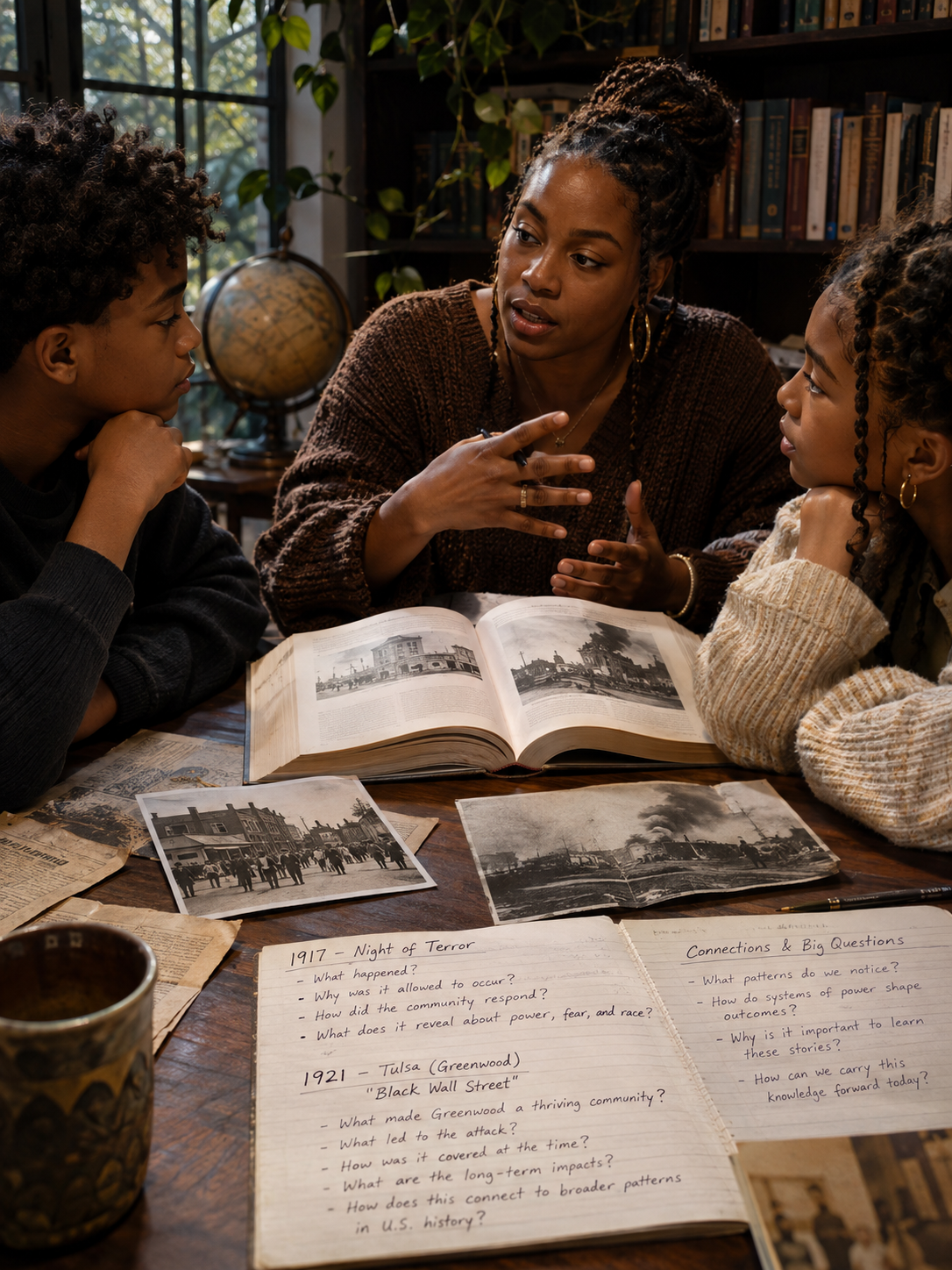
Here’s the work I hand over
Once I know what we’re trying to learn, I ask AI to help with the heavy gathering and assembling.
Find more context. Locate sources I can examine. Suggest videos. Pull out details we might want to investigate. Draft an explanation, organize my notes, or turn the material into a guide, website, or magazine.
Could I do all that research myself? Absolutely. In high school and college, I could disappear down a research rabbit hole for hours. I’d probably still enjoy it. But my life looks a little different now. I’m working a full-time job from home, homeschooling two neurodivergent kids, helping my mother from halfway across the country, and trying to build a business that helps other homeschool families. There are only so many hours, and only so many spoons, in a day.
I still want the deep connections and the interesting details. I just don’t have the time I once had to personally chase down every source, open every tab, and assemble every page before we even sit down to learn.
There’s a catch, though. I still have to review what comes back.
A link underneath an AI-written paragraph doesn’t automatically prove that paragraph is right. I need to open the source and check whether it actually says what the explanation claims. Same with videos. A video might be interesting, but is it accurate? Does it explain what we’re studying? More importantly, is it right for my kids? Something can be a perfectly good resource and still be completely wrong for the way either of them learns.
And then there are the discoveries that are genuinely fascinating but don’t belong in this guide. I can save those for another time. We don’t have to squeeze every rabbit hole into one afternoon.
The discussion questions are their own problem
I like using questions to find out how someone is thinking, not just whether they can repeat an answer. So I ask AI to help develop discussion questions, including Socratic-style ones.
The trouble is, I’ve had it give me basically the same questions across completely different topics.
They look thoughtful on the page. But what are they actually helping me find out?
Asking, ‘What did you find interesting?’ is actually a good place to begin. I want to know what caught their attention. My youngest is considering becoming a detective or a lawyer, so curiosity and asking questions are very much part of what we’re working on.
But stopping at ‘that was interesting’ doesn’t tell me whether they’re thinking critically about what we just discussed. Can they explain why? Compare two accounts? Use something from the resources we just went through to support an idea? Can they connect it to something happening today, or to another subject we’ve studied? That’s where the conversation gets useful.
For a history discussion, we might look at which source supports a claim, what’s missing from an account, or how one decision affected what happened next. And then we’ll follow whatever strange connection comes up. I tend to connect things across history, science, stories, and whatever else we’ve been exploring. Being a polymath probably has something to do with that. The kids have learned that a rabbit trail is sometimes where the best discussion happens.
It’s not just a conversation for the sake of avoiding a worksheet, either. Chris can take what he’s learned and work it into his videos. Kim can use those same reasoning skills when we get further into debates and forensics, and find out whether law or detective work really interests her.
We jokingly call ourselves an ‘anti-worksheet family,’ and yes, I’m putting air quotes around that. It doesn’t mean the kids never write. They still practice handwriting and grammar; we just teach those skills in other ways instead of making every subject depend on filling in a page.
When we sit down for history or science, talking through the material is often easier and faster. With one kid who’s more hyperactive and another whose ADHD is more inattentive, sitting through worksheet after worksheet can turn into a battle. And I do not have unlimited spoons to spend fighting over a page when we could be using that time to think, question, and connect ideas.
So yes, I let AI help draft questions. Then I check whether they’re going to help us actually use what we’ve learned. A page full of questions can look complete long before it’s ready to teach from.
And sometimes the tools become the problem
Here’s the part that doesn’t fit neatly into the usual ‘AI saves so much time’ conversation.
I spent about nine hours working on two workbooks. Roughly fifty pages altogether. And after all that, the pages still weren’t coming out the way I needed.
Nine hours.
The lesson content wasn’t the biggest problem. The way I was building the pages was. I was having AI generate each workbook page as an image, then taking those images into Canva and using Magic Layers so I could edit them. Sounds workable, right? Except then I was reformatting layouts, fixing text, and recreating the sketchnote-style pieces because they didn’t survive the Magic Layers process the way I needed them to. I was practically rebuilding the pages by hand.
At some point, that’s no longer helping me make a workbook. It’s just another project I have to troubleshoot.

What I figured out is that HTML is actually easier for ChatGPT to generate consistently than a whole workbook made of individually generated page images. Let AI build the workbook as HTML, make the necessary corrections there, save it as a PDF, and then bring the PDF into Canva if I want to make additional changes. That’s a very different process from generating fifty separate images and trying to rescue the text and layout afterward.
And no, that doesn’t mean every homeschool parent needs to learn HTML. The point is that I can have AI create the structure in a format it handles better. I don’t need another technical hobby just to get our school books finished. Once I changed the workflow, making the next workbook was easier.
Still doesn’t give me those nine hours back.
And that’s worth talking about. Sometimes AI removes a bunch of work right away. Sometimes it exposes a messy process we need to rethink. Sometimes the sensible decision is to stop trying to make one approach work and use a different one.
So what am I actually trying to get back?
My attention.
I want to know what we’re learning. I want to follow the odd connections, examine sources, and hear what the kids actually think. When Chris turns something into a video or Kim starts debating a question like a future lawyer, that’s not extra fluff around the lesson. That’s them using it. I like that part of teaching.
What I don’t need is to be the person manually holding every link, note, version, question, and half-finished document together in my head.
That’s what I want AI to help carry. Not my judgment. The assembly work around it.
And when we sit down with the lesson, I still have to listen. An organized, accurate guide doesn’t mean someone has learned the material. And a great discussion doesn’t mean we can skip teaching writing. Those are different skills, and both matter. Maybe we need a different example, more time with an idea, or a chance to use what we’ve learned in another setting. The guide gives us a place to begin. The actual learning happens in what we do with it.
If you want to try this, start smaller than a whole unit
Pick one lesson you already know well enough to review. Decide what you actually want the learner to understand. Then give AI one job.
Maybe you want a few sources to compare. Maybe you have a pile of notes that needs organizing. Maybe you want discussion questions about one specific idea. You can explain the learning goal without handing over a child’s name or personal history.
When it gives you something back, don’t just ask whether it looks finished. Ask whether you can check it, whether it fits your lesson, and how much work it takes to make it usable.
If it helped, great. You have something to work from. If you spent the whole time fixing formatting or sorting through irrelevant material, that’s information too. Change the process, not necessarily the learning goal.
For me, that’s where AI is most useful in homeschool. It helps me turn the decisions I’ve made into materials we can use, without making me assemble every last piece by hand.
And then I get to do the part I actually wanted to do in the first place: teach.