

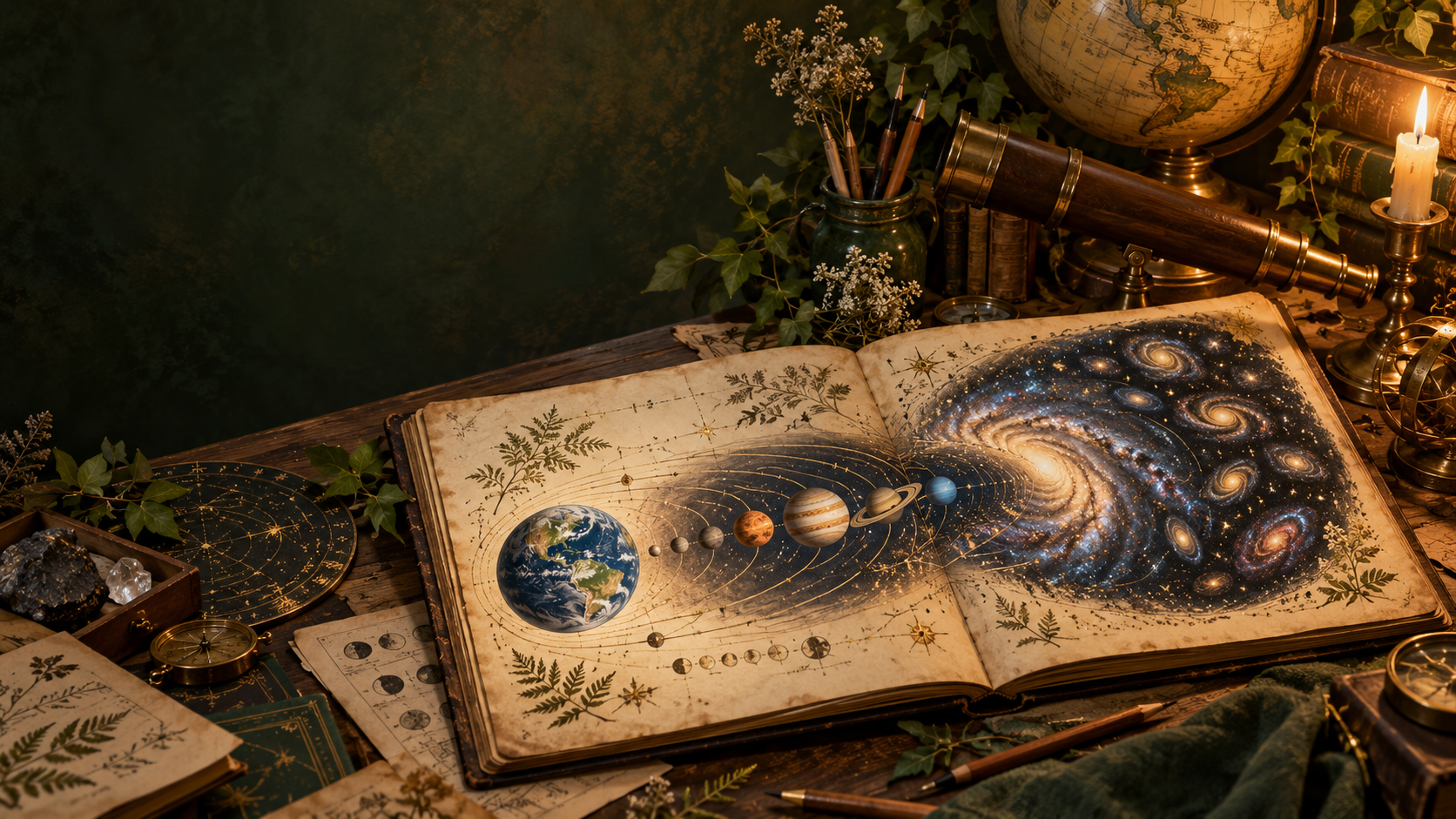
For the last eight weeks of our 2026 homeschool year, my 11-year-old daughter chose outer space for science.
Now, this wasn’t our first trip through the Solar System. We’d covered the planets a couple of years ago, back when the conversation was still centered around the usual elementary astronomy topics. You know, Mercury, Venus, Earth, Mars, and the ongoing disappointment that Pluto got demoted.
This time, we wanted to go a little further.
Instead of another overview of the planets, we decided to explore astrophysics.
Which sounds wonderful until you remember that astrophysics is an enormous subject, and you’re trying to make it understandable for an eleven-year-old and a fourteen-year-old.
We used Astrophysics for Young People in a Hurry as one of our resources. LeVar Burton narrates the audiobook, which was a definite plus for the kids. They enjoyed listening to him, although I can’t say they were equally enthusiastic about every chapter.
Some of the material was dense. We finished the book, but there were definitely parts that required more explanation, and some of our most interesting conversations came from the rabbit trails we wandered down along the way.
And that’s one of the reasons I love teaching science this way.
Following an interest doesn’t mean following every possibility
Science is one of the subjects where I give the kids more say in what we study.
Sometimes that means revisiting a subject we’ve already explored. Other times, it means following a question into territory that’s more complicated than either of us expected.
The challenge isn’t usually finding enough material.
It’s deciding what actually belongs in the lesson.
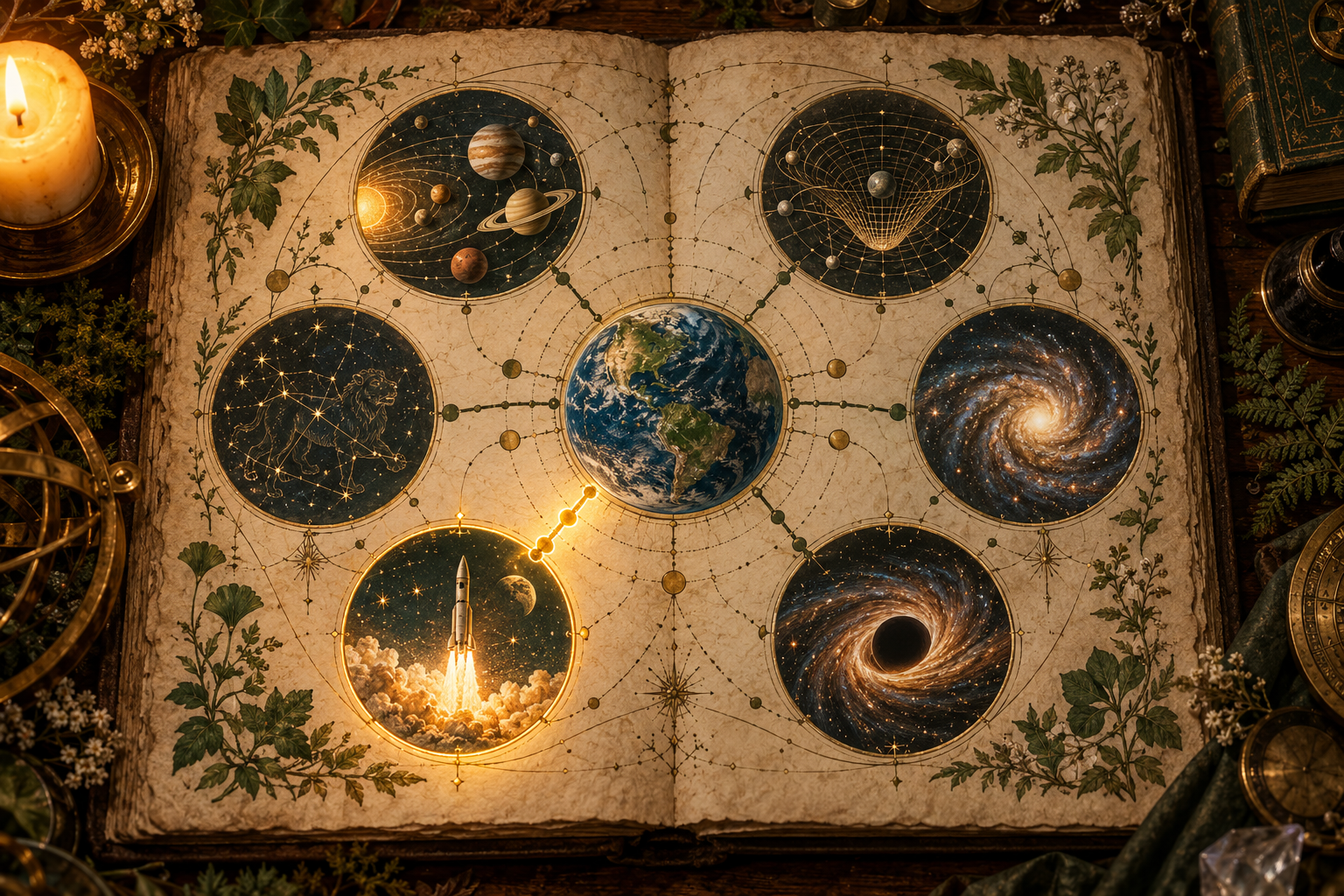
Take outer space, for example. We could study the planets, gravity, black holes, rockets, mythology, astronomy’s history, space exploration, or how scientists measure distances across the universe.
Any one of those could turn into an entire unit.
And if I tried to connect every interesting possibility before we started, I’d spend more time building the curriculum than actually teaching it.
I know because we’ve spent years buying homeschool curriculum only to rewrite large portions of it to fit the way our kids learn.
So I’ve become much more deliberate about separating the subject we’re exploring from what we’re actually trying to understand in a particular lesson.
Even when I know we’re going to spend several weeks on something, I don’t need every possible connection worked out before we begin.
I need to know where we’re starting.
Before we could explore the universe, we needed to know where we were
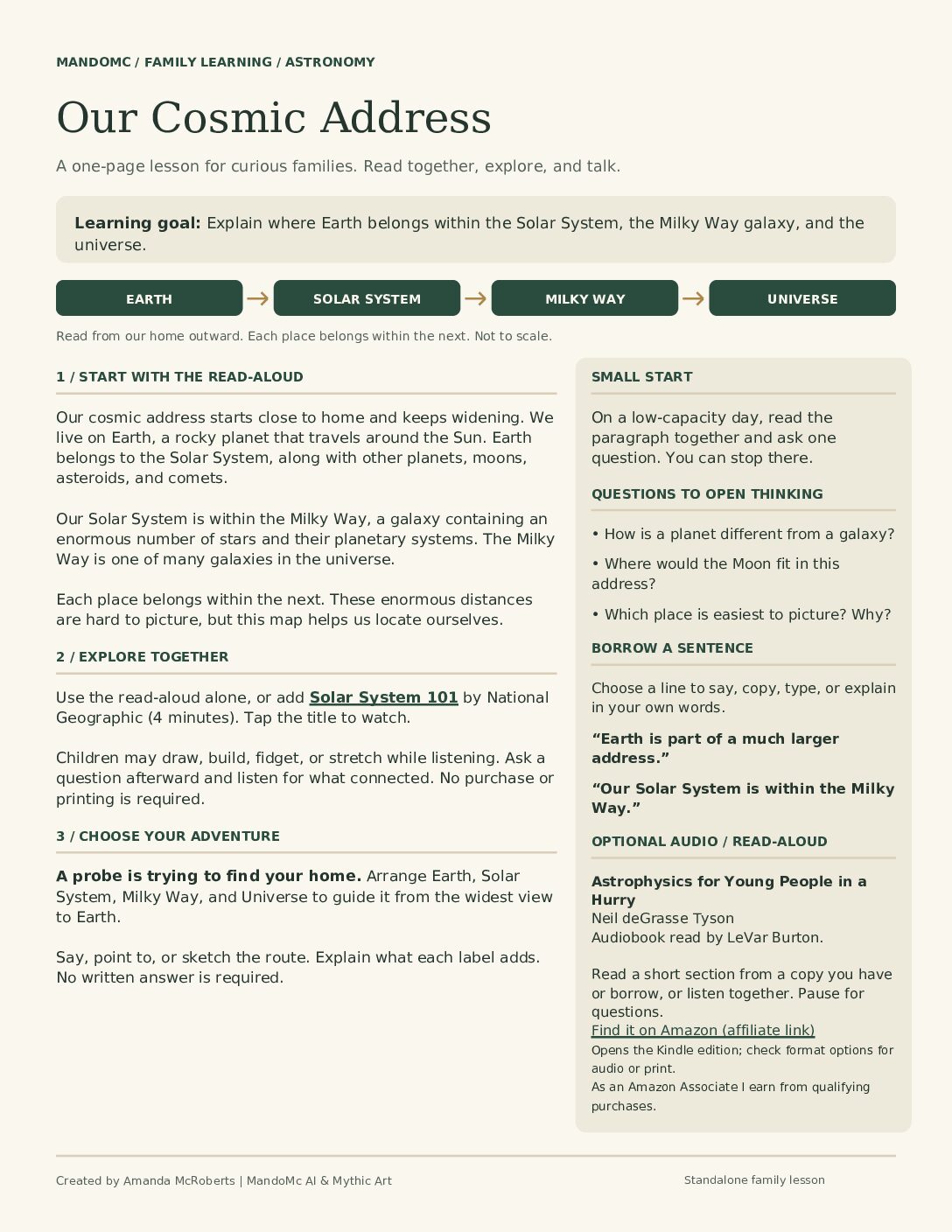
That was the thinking behind the first lesson in our astrophysics unit: Our Cosmic Address.
Before getting into some of the more complicated ideas, I wanted my son and daughter to have a foundation for understanding where Earth actually fits into the universe.
Most kids learn that Earth is the third planet from the Sun. They learn the names of the other planets, maybe a few interesting facts about each one, and that our Solar System is part of the Milky Way.
But understanding how those pieces fit together is a little different from memorizing the names.
So the question became:
If Earth has an address in the universe, what would that address look like?
Think about how we describe where we live.
Our house is on a street. That street is in a town. The town is in a state, which is part of a country, which is part of Earth.
Each level gives us a little more context.
Now we can take that same idea and look outward.
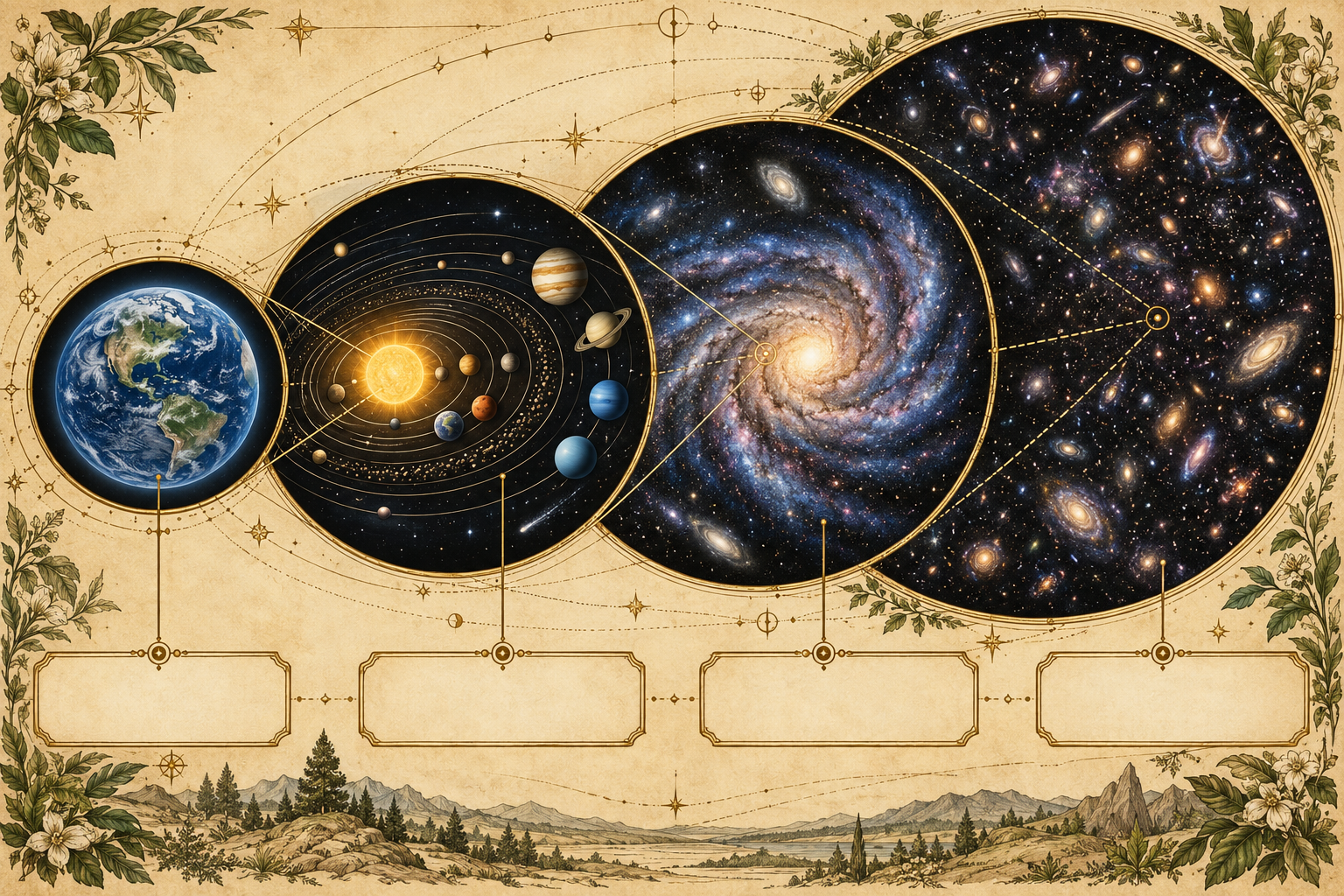
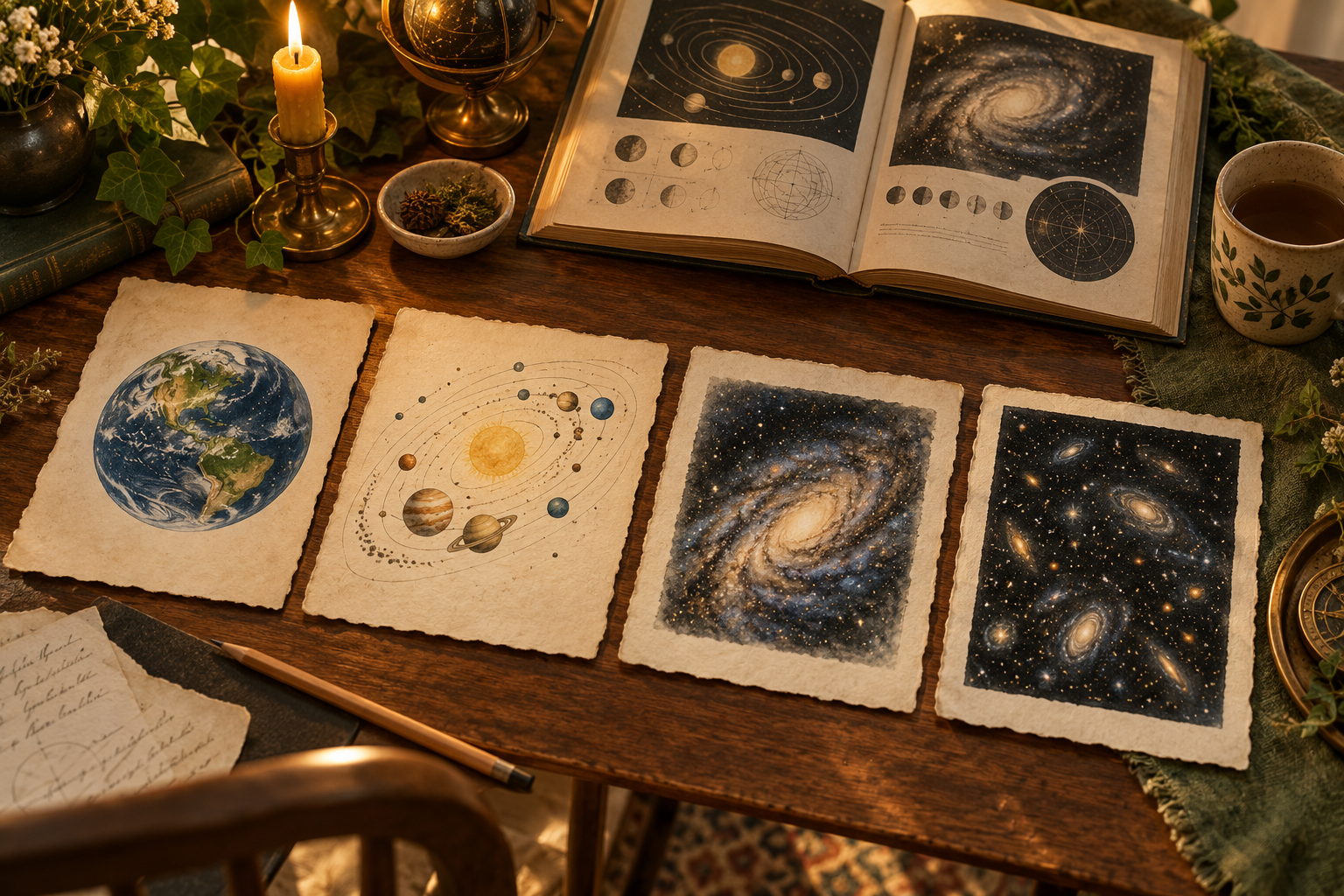
Earth → Solar System → Milky Way → Universe
Obviously, the universe isn’t organized like a neighborhood, and those labels tell us very little about the enormous distances involved.
But that’s okay. We weren’t trying to explain the entire structure of the cosmos in one sitting.
We were trying to understand one relationship: where Earth belongs within larger astronomical structures.
That’s a lesson we could actually work with.
One connection can carry an entire lesson
Here’s where I think interest-led learning gets particularly interesting.
The connection between a mailing address and our place in the universe isn’t especially complicated. But it gives us a familiar way to organize something that is otherwise difficult to visualize.
And once that connection is established, there are several ways to explore it.
For Our Cosmic Address, I created a short explanation, a visual map, discussion questions, and a little adventure involving a space probe trying to find its way home.
The idea is to work backward from the universe toward Earth, figuring out where the probe needs to go and what each location means.
It gives the kids something to think through instead of just memorizing four labels.
And it doesn’t require an elaborate project.
You could use the lesson page, write the four locations on pieces of paper, or simply talk through the relationships together.
The important part isn’t how impressive the finished activity looks.
It’s whether the child understands what they’re describing.
For example, a child might put Earth, Solar System, Milky Way, and Universe in the right order because they’ve memorized the sequence.
But can they explain why the Solar System is part of the Milky Way? Do they understand the difference between a planet and a galaxy?
Those questions tell us more about their understanding than the order alone.
And if they can’t explain it yet, we know what needs more attention.
Not every connection needs an assignment
Now, we could take the cosmic address idea quite a bit further.
We could write a fictional postcard from another planet. Compare distances. Study how astronomers map galaxies. Research the Voyager probes. Build a model of the Solar System.
There’s nothing wrong with any of those activities.
In fact, some of them sound like a lot of fun.
But they don’t all have to happen in the same lesson.
This is something I’ve had to pay attention to when creating our homeschool materials, especially because I genuinely enjoy making connections between subjects.
One idea leads to another, which leads to another, and suddenly we’re three research tabs and a documentary into something completely different.
Sometimes that’s exactly where the interesting learning happens.
Other times, we’ve wandered so far from the original question that we’ve forgotten what we were trying to understand.
The distinction I’ve found useful is whether a connection actually helps us explore the question we’re asking.
If we’re studying where Earth fits in the universe, discussing the difference between a planet and a galaxy makes sense.
Researching every spacecraft humanity has launched might be fascinating, but it isn’t necessary to understand our cosmic address.
We can save that for another day.
Or follow it right then, if that’s where the conversation takes us and we have room for it.
The point is that finding a connection doesn’t automatically make it another requirement.
The lesson doesn’t have to look the same for every child
One of the things I’ve learned from homeschooling my son and daughter is that understanding something and demonstrating that understanding aren’t always the same task.
A child might be able to explain an idea out loud but struggle to put it into a paragraph.
Another might prefer drawing a diagram, arranging objects, or showing you how something works.
That doesn’t mean writing isn’t important. We still teach writing.
It means I need to be clear about what we’re actually assessing.
If today’s science goal is understanding how Earth fits within the universe, I don’t necessarily need a written report to find out whether that understanding is there.
I can ask them to explain the map.
I can have them arrange the labels.
We can talk through the question together and see where the explanation holds up or falls apart.
And if the goal is writing, that’s a different lesson with its own expectations.
I don’t need to make every activity prove every skill at once.
That’s part of what makes a single, focused lesson useful. We can change how we explore or demonstrate the idea without losing sight of what we’re learning.
Where AI fits into this
I’ve been using AI to help research, organize, and create our homeschool materials for about a year now.
Not because I want AI deciding what my children should learn.
I want it to help with the enormous amount of work that happens between choosing a subject and having something usable to teach from.
When we’re exploring a topic like astrophysics, there are plenty of resources available. Finding information isn’t particularly difficult.
Sorting through it, determining what belongs together, checking the explanations, and turning it into something both children can work with is where things become more complicated.
That’s where AI can be useful.
For a lesson like this, I can give it the topic, the specific learning goal, and the resources I want to work from. Then I can use it to help organize the information, suggest connections, or draft materials for me to review.
But I still have to check the science.
I still have to decide whether the explanation makes sense.
And I still have to determine whether the material actually fits my children.
AI doesn’t know my children simply because I’ve given it their ages or described how they learn.
It can help me build the materials.
It can’t replace my judgment about whether those materials are right for them.
And sometimes that means correcting the first draft, simplifying an explanation, changing the activity, or throwing out a suggestion altogether.
Which, to be fair, is not all that different from what I’ve been doing with purchased curriculum for years.
Now I have another way to build what we need.

Start with the next question, not the entire unit
Our astrophysics study was an eight-week exploration, and Our Cosmic Address was only the beginning.
We didn’t choose to study space because I wanted to squeeze astronomy into every subject. We chose it because my daughter was interested in exploring it further, and we had an opportunity to build on what we’d learned a few years earlier.
That interest gave us a direction.
Our first lesson gave us a place to start.
And the rest of the exploration didn’t have to be contained inside that first lesson.
If your child is interested in dinosaurs, you don’t have to plan paleontology, geology, prehistoric ecosystems, evolution, and a museum project before you can begin.
You could start with one question about a dinosaur they find fascinating.
If they’re interested in baking, maybe the first question is why bread rises.
If they’re interested in video games, maybe it’s how a character moves through a three-dimensional world.
The question gives you something specific to investigate. From there, you can choose a resource, explore the idea together, and see what your child understands.
You might discover the beginning of a much larger study.
You might have one interesting afternoon and move on to something else.
Both are perfectly reasonable outcomes.
Because curiosity doesn’t come with a requirement to turn every interesting idea into eight weeks of assignments.
Sometimes one question is enough to begin.
Explore Our Cosmic Address
If you’d like to see what that first astrophysics lesson looks like, I’ve made Our Cosmic Address available as a standalone resource.
It introduces Earth’s place in the Solar System, Milky Way, and universe through a short explanation, visual map, discussion questions, and a space-probe adventure.
You can use the whole lesson or simply borrow the question and explore it together.
And if that question sends you down an entirely different rabbit trail?
Well, that’s part of the fun of homeschooling.